
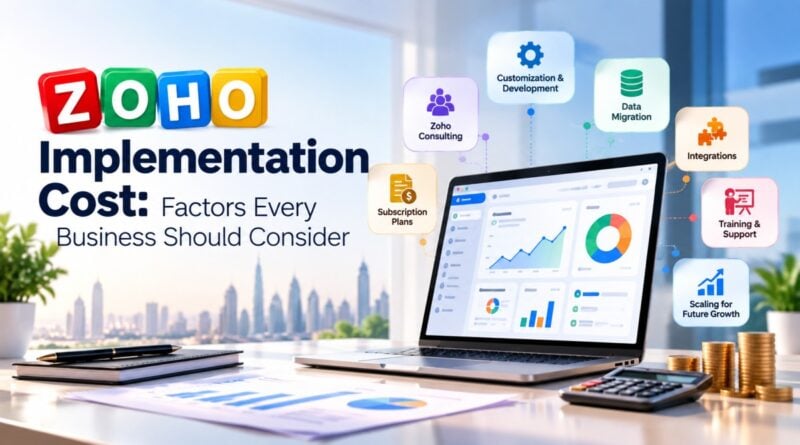
Zoho Implementation Cost: Factors Every Business Should Consider
Zoho offers a range of business applications that help organizations manage sales, finance, customer relationships, HR, and daily operations. However, the total cost of adopting these tools depends on more than the software subscription. Businesses must also consider customization, data migration, integrations, employee training, and ongoing support.
Understanding the factors that influence Zoho implementation cost can help businesses plan their budgets and choose the right solution for their requirements. With professional Zoho implementation, Zoho development, and Zoho consulting, companies can build a system that supports their business goals without unnecessary expenses.
What Is Zoho Implementation?
Zoho implementation is the process of configuring and deploying Zoho applications according to a company’s business requirements. It may include setting up Zoho CRM, Zoho Books, Zoho People, Zoho Desk, Zoho Creator, or Zoho One.
A typical implementation project can involve:
- Business process analysis and requirement gathering
- Application configuration and workflow automation
- Data migration from existing systems
- Third-party software integration
- Custom application development
- Employee training and technical support
The overall investment depends on the number of applications, the complexity of the project, and the level of customization required.
Key Factors That Affect Zoho Implementation Cost
1. Choice of Zoho Applications and Subscription Plans
The first factor is the Zoho product you choose. Different applications offer different features and pricing structures. For example, Zoho CRM focuses on sales and customer management, while Zoho Books supports accounting and financial operations.
Businesses using multiple applications may also consider Zoho One, which provides access to a broad suite of business tools under eligible subscription plans.
The subscription cost generally depends on the selected edition, number of users, billing frequency, and applicable plan conditions. Before selecting a plan, evaluate your current requirements and expected business growth.
2. Customization and Zoho Development
Every business has unique workflows, reporting needs, and operational requirements. Standard application settings may be sufficient for some organizations, while others need more advanced customization.
Professional Zoho development can include:
- Custom modules and fields
- Advanced workflow automation
- Custom dashboards and reports
- Zoho Creator application development
- Deluge scripting and business logic
- Custom functions and API integrations
More complex development typically requires additional time, technical expertise, and testing. To manage costs, prioritize essential custom features first and introduce additional functionality when needed.
3. Data Migration and Data Cleaning
Moving existing business data into Zoho is another important cost consideration. Companies may need to migrate information from spreadsheets, legacy CRM platforms, accounting software, or other business applications.
Data migration may involve exporting records, mapping fields, cleaning duplicate entries, validating information, and testing imported data.
Poor data quality can lead to errors after implementation. Investing in data preparation facilitates a smoother transition and helps minimize future problems.
4. Third-Party Integrations
Many businesses rely on multiple systems for marketing, payments, customer support, inventory, and communication. By integrating these platforms with Zoho, productivity can increase and manual labor can be decreased.
Integration requirements may include:
- Website and lead-generation form integration
- Email marketing and communication tools
- Payment gateways and accounting platforms
- E-commerce and inventory systems
- External applications through APIs
The cost depends on integration complexity, API availability, data synchronization requirements, and whether custom development is necessary.
5. Zoho Consulting and Business Process Analysis
Professional Zoho consulting helps businesses identify the right applications, define workflows, and plan an implementation strategy.
Consultants may review existing processes, identify automation opportunities, recommend suitable Zoho products, and create a deployment roadmap.
Although consulting adds to the initial project budget, it can help prevent unnecessary customization, poor application selection, and expensive implementation mistakes.
6. Employee Training and Change Management
Even a well-configured system may deliver limited results if employees do not know how to use it effectively.
Training costs depend on the number of users, training sessions, documentation requirements, and complexity of the workflows. Businesses may need role-based training for sales teams, finance departments, HR professionals, and administrators.
A structured onboarding process can improve user adoption and help employees benefit from the new system sooner.
7. Maintenance, Support, and Future Enhancements
When the system becomes live, Zoho implementation doesn’t always finish. Businesses may require ongoing technical support, workflow improvements, application updates, troubleshooting, and additional integrations.
When estimating the total cost, consider recurring support arrangements and future development requirements. A long-term maintenance plan can help keep the system aligned with changing business needs.
How Can Businesses Optimize Zoho Implementation Costs?
Businesses can control implementation expenses without compromising essential functionality by following these practices:
- Define clear requirements: Identify the main business problems before choosing applications.
- Start with essential features: Start with essential workflows and work your way up.
- Choose the right subscription: Avoid paying for features or user licenses you do not need.
- Prepare data in advance: Clean existing records before migration begins.
- Prioritize valuable integrations: Focus on integrations that save time or improve data accuracy.
- Work with experienced professionals: Select a Zoho partner who possesses the necessary implementation and development skills.
- Measure results: Measure outcomes by keeping tabs on adoption, automation effectiveness, and process enhancements.
These steps help businesses allocate their budgets effectively and avoid unnecessary project complexity.
Why Choose Professional Zoho Services?
Working with an experienced provider can simplify the implementation process and ensure the system is configured around your business objectives.
Professional Zoho services may include implementation planning, CRM customization, application integration, workflow automation, Zoho development, employee training, and ongoing technical support.
A qualified Zoho partner can also help identify opportunities to connect different applications and reduce repetitive manual tasks. When evaluating providers, review their technical capabilities, project experience, support arrangements, and understanding of your industry.
The right partner should offer a practical solution that fits your requirements rather than recommending unnecessary features.
Conclusion
Zoho implementation cost varies according to subscription plans, customization, data migration, integrations, consulting, training, and ongoing support. There is no single price that fits every business because each project has different technical and operational requirements.
Before starting your project, prepare a clear list of objectives, identify the applications you need, and request a detailed estimate covering both initial implementation and recurring expenses.
With the right implementation strategy and professional support, businesses can make better use of Zoho applications, automate routine tasks, and build a scalable system for long-term growth.
Looking for professional Zoho implementation support? VerticalisBS can help businesses explore Zoho implementation, Zoho development, and consulting solutions tailored to their operational needs. Contact the team to discuss your requirements and implementation goals.