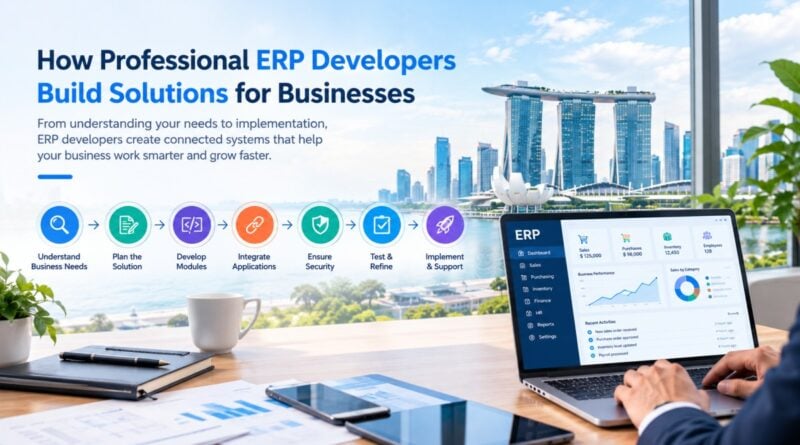
How Professional ERP Developers Build Solutions for Businesses
Every business has its own way of managing daily operations. Some organisations focus on manufacturing and inventory, while others need better control over sales, finance, purchasing, and customer information. As companies expand, managing these activities through separate applications can become challenging.
This is where professional ERP developers play an important role. They help businesses create connected software systems that simplify workflows, improve information management, and support future growth. The increasing demand for ERP development in Singapore reflects the need for flexible technology that can adapt to changing business requirements.
1. Understanding Business Requirements
Professional ERP development starts with understanding how a company operates. Developers first examine existing processes, identify operational difficulties, and discuss the organisation’s long-term objectives.
This assessment helps determine which activities need improvement and what features should be included in the ERP system.
For example, a manufacturing company may require production planning, raw material tracking, and quality management. A retail organisation may need inventory control, sales tracking, and supplier management.
Understanding these differences helps developers create solutions that match actual business needs.
2. Creating a Custom ERP Development Strategy
After reviewing business requirements, developers prepare a structured development plan. This includes selecting the required modules, defining system architecture, choosing suitable technologies, and establishing development priorities.
A well-planned ERP strategy also considers future business expansion.
Instead of developing every feature at once, companies can prioritise essential functions and introduce additional modules when required. This approach helps control development complexity while keeping the system flexible.
3. Developing Modules Around Business Operations
ERP software connects different departments through a centralised platform. Professional developers build individual modules that work together to support everyday business activities.
Common ERP modules include:
-
Finance and Accounting: Handles invoices, payments, expenses, and financial reporting.
-
Inventory Management: Tracks stock availability, warehouse movements, and product records.
-
Sales Management: Manages quotations, customer orders, and sales activities.
-
Purchase Management: Organises supplier information, purchase orders, and procurement processes.
-
Human Resource Management: Maintains employee records, attendance, and leave information.
-
Production Management: Supports manufacturing schedules, material requirements, and production monitoring.
The selected modules depend on the company’s size, industry, and operational requirements.
4. Connecting Existing Business Applications
Many organisations already depend on different software applications for their daily activities. Replacing every existing platform may not always be practical.
Professional ERP developers focus on connecting relevant applications through APIs and other integration methods.
For example, an ERP system can exchange information with an e-commerce platform, accounting application, payment gateway, or CRM software.
This reduces repeated data entry and allows departments to work with more consistent information.
5. Prioritising Security and Data Management
Business software often contains confidential financial records, employee details, customer information, and supplier data. Protecting this information is an important part of ERP development.
Developers can implement role-based permissions, authentication mechanisms, activity logs, and controlled access to sensitive information.
They also design database structures that support reliable information storage and retrieval.
For Singapore businesses, security planning should consider applicable data protection requirements, including the Personal Data Protection Act (PDPA), where relevant.
6. Testing the ERP System Before Launch
A properly developed ERP platform must be tested before employees start using it.
Developers perform functional testing, integration testing, performance checks, and security assessments to identify potential issues.
User acceptance testing also helps confirm whether the system supports actual business workflows.
Resolving problems before deployment can reduce disruptions and improve employee confidence in the new software.
7. Implementation, Training, and Ongoing Support
ERP development does not end when the software is ready. Successful implementation requires data migration, system configuration, employee training, and regular monitoring.
Developers may also provide maintenance services, technical assistance, and feature improvements after deployment.
As business requirements change, the ERP platform can be updated with additional functionality to support new processes.
Conclusion
Professional ERP developers build more than business management software. They create connected solutions that bring departments together, reduce repetitive activities, and improve operational visibility.
For companies considering ERP development in Singapore, selecting an experienced development partner is an important step towards building a reliable and scalable system.
SerpentCS helps businesses explore customised ERP development solutions designed around their specific requirements. With proper planning, technical expertise, and ongoing support, businesses can establish a stronger digital foundation for long-term growth.